

 Request an Appointment







Geneva’s Keeper of Time: The Patek Philippe Museum
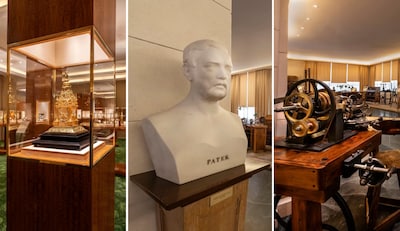
Located in the heart of Geneva, the Patek Philippe Museum has become one of the city's most recognised cultural landmarks. In a place long associated with the art of timekeeping, the museum serves as a quiet custodian of horological history, and is home to one of the world’s most significant collections of timepieces.
Born from the lifelong passion of Philippe Stern, former President of Patek Philippe, the museum tells the story of more than five centuries of Genevan, Swiss and European watchmaking artistry – not just through the lens of a single brand but exploring the long, intricate story of timekeeping itself, offering visitors the chance to discover more about the evolution of this unique and beautiful craft.
The Art Deco building itself also has a story to tell. It was once home to the Les Ateliers Réunis – Patek Philippe’s own production unit for cases and bracelets – where traditional Genevan goldsmithing techniques were practised well into the 20th century. After these workshops were relocated in the late 1990s, the building underwent a careful renovation and discreet expansion before reopening in 2001 as a museum. It is the perfect space in which to display the collection and tell the story of the city’s watchmaking heritage, as it has retained the proportions, light and industrial character of its previous life, as well as a quiet sense of place shaped by watchmakers over generations.
Comprising more than 2,500 pieces, the collection reveals the fascinating history of horology across several floors. Early watches from the 16th and 17th centuries – heavy, ornate and more symbolic than practical – remind visitors that convenience and portability once mattered less than artistry. As the timeline moves forward, the pieces become more complex, and include landmark creations such as the very first Patek Philippe wristwatch, dating from 1868, and the first known perpetual calendar wristwatch – another Patek Philippe innovation, created in 1925. The collection illustrates how mechanical and scientific precision began to advance and intersect with haute horology. Minute movements, enamelled cases, grand complications and decorative flourishes trace the journey of watchmaking as it finds the balance between engineering and fine art.
Patek Philippe’s story is presented as a key strand woven into this wider tapestry. Its early pocket watches and pioneering wristwatches are important markers in the history of Swiss watchmaking, and even its more complicated pieces appear as milestones within a much longer tradition, rather than isolated achievements for the brand. It is this approach that gives the museum its authenticity; it avoids self-promotion, and instead positions the brand within the progression of the craft.
The museum also gives a glimpse into the world of restoration, honouring the building’s heritage as a house of craftsmanship. Hand-forged tools and rows of antique workbenches reveal how gears were shaped, dials engraved and movements assembled long before industrialisation. Some of them remain in use to this day by the watchmakers working in the museum, restoring antique pieces and demonstrating skills that might otherwise have been lost over time.
Upstairs, the library – the brain of the museum – holds over 8,000 archive items, from books to technical drawings, giving further historical context to the timepieces on display. This area reinforces the museum’s purpose as not only an exhibition space but also a centre for study, where the technical, scientific and artistic aspects of timekeeping are preserved with the same care as the pieces themselves.
Ultimately, the Patek Philippe Museum represents continuity and the preservation of craftsmanship. It demonstrates that watchmaking is not simply a display of precision engineering or decorative art but a craft shaped by generations of human hands and minds – something a machine could not replicate. It captures the living story of timekeeping, and in doing so it reflects the philosophy that defines Patek Philippe: time is never owned, as each generation is simply safeguarding it for those who follow.
Born from the lifelong passion of Philippe Stern, former President of Patek Philippe, the museum tells the story of more than five centuries of Genevan, Swiss and European watchmaking artistry – not just through the lens of a single brand but exploring the long, intricate story of timekeeping itself, offering visitors the chance to discover more about the evolution of this unique and beautiful craft.
The Art Deco building itself also has a story to tell. It was once home to the Les Ateliers Réunis – Patek Philippe’s own production unit for cases and bracelets – where traditional Genevan goldsmithing techniques were practised well into the 20th century. After these workshops were relocated in the late 1990s, the building underwent a careful renovation and discreet expansion before reopening in 2001 as a museum. It is the perfect space in which to display the collection and tell the story of the city’s watchmaking heritage, as it has retained the proportions, light and industrial character of its previous life, as well as a quiet sense of place shaped by watchmakers over generations.
Comprising more than 2,500 pieces, the collection reveals the fascinating history of horology across several floors. Early watches from the 16th and 17th centuries – heavy, ornate and more symbolic than practical – remind visitors that convenience and portability once mattered less than artistry. As the timeline moves forward, the pieces become more complex, and include landmark creations such as the very first Patek Philippe wristwatch, dating from 1868, and the first known perpetual calendar wristwatch – another Patek Philippe innovation, created in 1925. The collection illustrates how mechanical and scientific precision began to advance and intersect with haute horology. Minute movements, enamelled cases, grand complications and decorative flourishes trace the journey of watchmaking as it finds the balance between engineering and fine art.
Patek Philippe’s story is presented as a key strand woven into this wider tapestry. Its early pocket watches and pioneering wristwatches are important markers in the history of Swiss watchmaking, and even its more complicated pieces appear as milestones within a much longer tradition, rather than isolated achievements for the brand. It is this approach that gives the museum its authenticity; it avoids self-promotion, and instead positions the brand within the progression of the craft.
The museum also gives a glimpse into the world of restoration, honouring the building’s heritage as a house of craftsmanship. Hand-forged tools and rows of antique workbenches reveal how gears were shaped, dials engraved and movements assembled long before industrialisation. Some of them remain in use to this day by the watchmakers working in the museum, restoring antique pieces and demonstrating skills that might otherwise have been lost over time.
Upstairs, the library – the brain of the museum – holds over 8,000 archive items, from books to technical drawings, giving further historical context to the timepieces on display. This area reinforces the museum’s purpose as not only an exhibition space but also a centre for study, where the technical, scientific and artistic aspects of timekeeping are preserved with the same care as the pieces themselves.
Ultimately, the Patek Philippe Museum represents continuity and the preservation of craftsmanship. It demonstrates that watchmaking is not simply a display of precision engineering or decorative art but a craft shaped by generations of human hands and minds – something a machine could not replicate. It captures the living story of timekeeping, and in doing so it reflects the philosophy that defines Patek Philippe: time is never owned, as each generation is simply safeguarding it for those who follow.
